
Explore hot-dip galvanized solar mounting structures for residential, commercial and industrial projects. The structure and fixing design must match the roof, module dimensions, proposed loads and site conditions. Provide drawings and roof details so the required materials, hardware and installation scope can be specified.
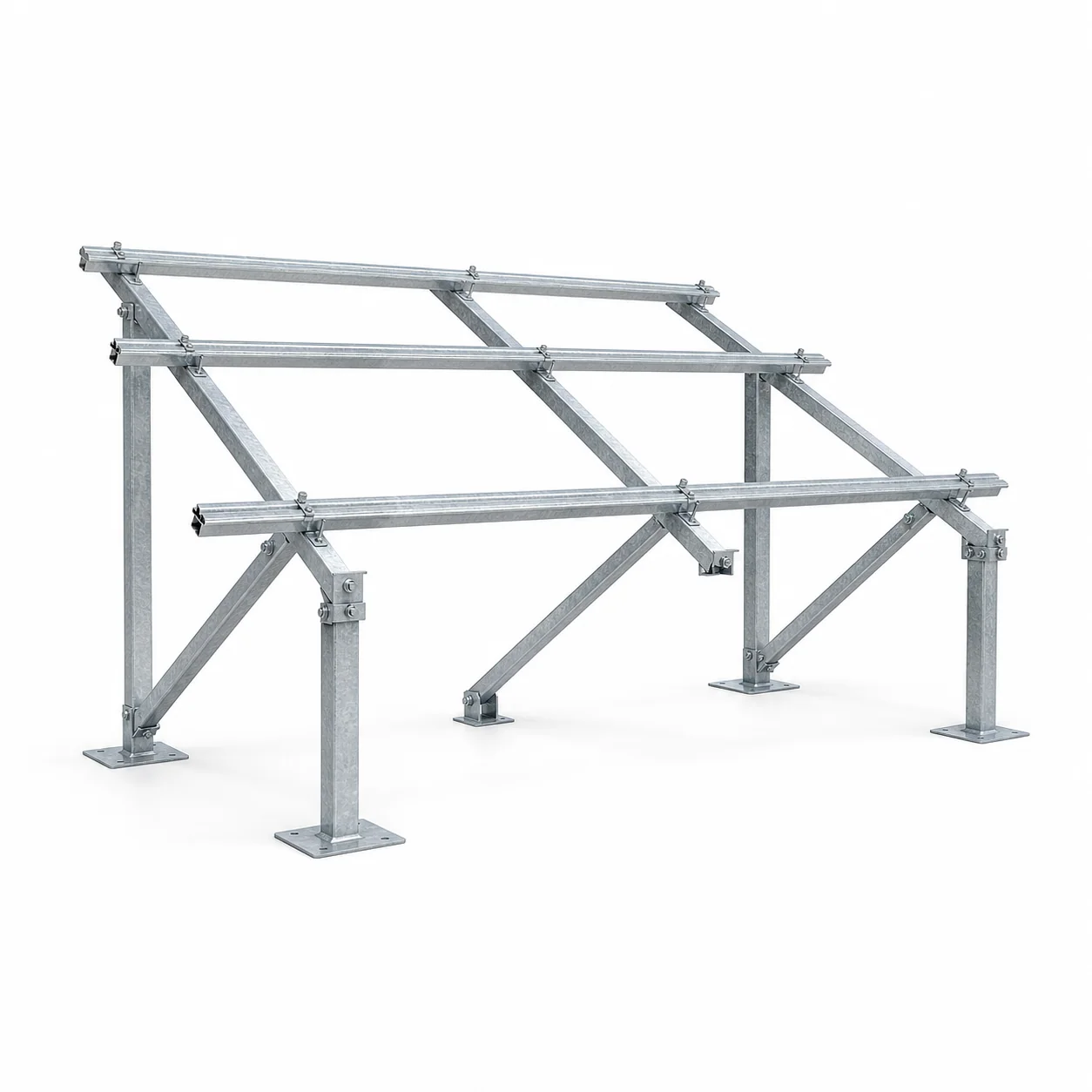
Hot-Dip Galvanized Solar Structure
| Material | Mild Steel, Hot-Dip Galvanized |
|---|---|
| Coating | Hot-dip galvanized coating for enhanced corrosion resistance |
| Thickness | Request current datasheet |
| Roof Type Suitability | RCC, ground mount, industrial rooftops |
| Capacity Compatibility | Request current datasheet |
Galvanizing provides corrosion protection, while structural capacity and module compatibility depend on the designed assembly and fixing details. Confirm material sections, coating requirements, anchors and maintenance instructions for the proposed installation.
Solar Structure Accessories
Nuts, bolts, brackets and fixing accessories required to complete a structure installation. Explore the full range on our Solar Accessories page.
View Structure AccessoriesEnquire About Solar Structures
Treat mounting as an engineered part of the system
A roof-specific layout must consider module dimensions, wind loads, anchorage, structural capacity, waterproofing and maintenance access. Hot-dip galvanized material alone does not prove a completed structure is suitable for a particular building.
Send roof details and drawings for a structure quotation, and state whether design, fixing hardware, delivery and installation are required.
Roof type changes the mounting design
A concrete roof needs a designed fixing or ballast arrangement with load and waterproofing checks. A sheet roof requires suitable attachment details and an understanding of the underlying structure; the visible sheet is not the only load-bearing element.
Confirm setbacks, drainage, roof obstructions and maintenance access. The selected module dimensions and fixing instructions constrain the layout. Do not infer that a taller or heavier frame is automatically suitable.
What to include in a structure supply schedule
Specify the material, section dimensions, corrosion protection, module arrangement and connection details required by the design. Include clamps, rails, anchors and fasteners as an itemised schedule, rather than assuming all fixing hardware is included.
Hot-dip galvanizing describes a corrosion-protection process. Actual structural suitability still depends on design, fabrication and anchorage. Request the relevant documentation for the supplied assembly.
Confirm the responsibilities at the roof interface
Agree who assesses structural adequacy, who approves penetrations and who is responsible for waterproofing. Any change to existing roof warranties should be reviewed with the appropriate owner or manufacturer.
After installation, retain the mounting layout and the agreed inspection requirements. Qualified personnel should investigate loose, damaged or corroded parts; do not retighten a loaded array without the appropriate procedure.
Mounting accessory list · Engineering and installation scope
Clear answers
Frequently asked questions
What is a solar mounting structure?
A mounting structure supports photovoltaic modules and transfers loads to the roof or ground through a designed fixing arrangement.
What is hot-dip galvanizing?
Hot-dip galvanizing applies a zinc coating to steel to help protect it from corrosion. Confirm the material and coating specification for the ordered structure.
Is one structure suitable for every roof?
No. Concrete roofs, metal roofs and other surfaces need different fixing details, load checks and waterproofing approaches.
How is the mounting tilt selected?
Tilt depends on layout, energy objectives, shading, wind loading and roof constraints. Greater tilt is not automatically better for every installation.
Can a structure be installed without penetrating the roof?
Some designs use ballast or roof-specific clamps, but suitability depends on structural capacity and wind design. Obtain a qualified assessment.
Why are wind loads important?
Wind can impose uplift and lateral forces on the array. Structure and anchorage must be designed for the site conditions.
What is the difference between mid clamps and end clamps?
Mid clamps secure adjacent modules; end clamps secure modules at array edges. Both must match module frames and the mounting rail design.
Can I use generic fasteners for a solar structure?
Use fasteners specified for the design, material compatibility and corrosion conditions. Unverified substitutions can compromise the assembly.
Who checks roof loading?
A qualified structural professional should evaluate the roof where required. The module weight alone does not represent the complete structural load.
What dimensions are needed to quote a structure?
Share module dimensions, quantity, layout, roof type, desired clearance and site location, along with available structural drawings.
Are structure and waterproofing warranties the same?
No. Ask who is responsible for the structure, roof penetrations and waterproofing, and obtain the relevant terms in writing.
Can I enquire about structure-only supply?
Yes. Specify the design and quantities needed. Confirm whether engineering, anchoring, delivery and installation are included in the quotation.