
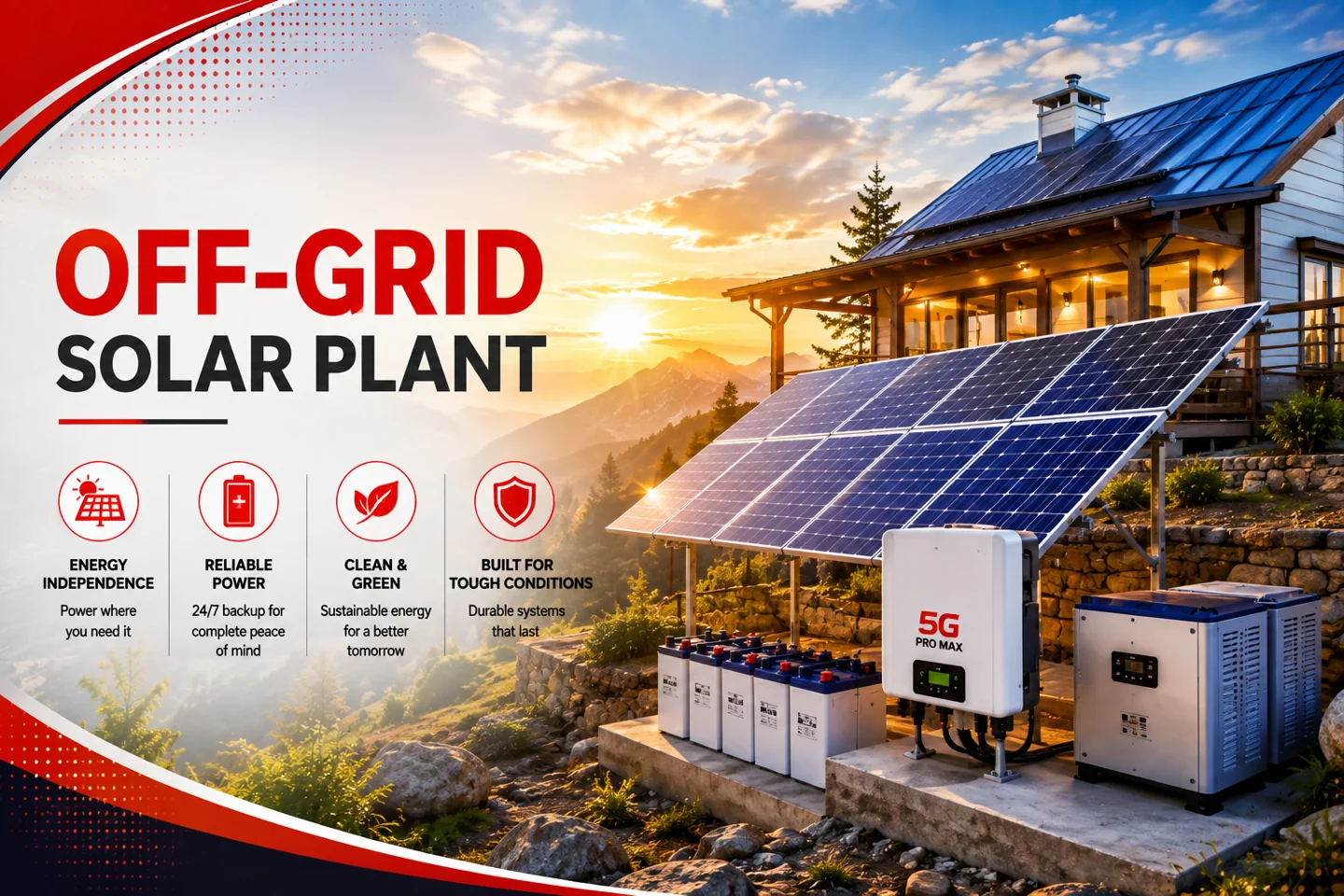
An off-grid solar plant operates independently of the utility grid, storing generated solar energy in batteries for use at any time. This makes it suitable for remote locations or properties without reliable grid access.
- Fully independent power supply
- Battery bank sized to your daily load and required backup hours
- Suitable for remote homes, farms and off-grid facilities
- Site survey to determine battery and panel sizing
Size the standalone system for energy and peak demand
List appliance wattages and running hours, then identify peak and starting loads. Reserve for low-sun periods, usable battery limits and safe equipment placement need design attention.
A standalone system is different from an approved grid-export installation. Do not assume that residential grid-connected assistance applies to an off-grid purchase.
Size energy supply separately from peak power
Daily consumption comes from appliance power and operating hours. Peak and starting loads determine the power the inverter must supply at a particular time. Both matter to an off-grid design.
Review seasonal demand, expected low-sun conditions and usable battery reserve. A reliable proposal states its assumptions and operating limits rather than relying on one fixed national generation average.
Decide which loads are practical for the system
Long-running heating, cooling or pumping can dominate energy demand. Review essential use, operating schedules and any suitable load-management approach with the designer.
Battery reserve is finite. If an alternative backup source is required, its integration must follow a compatible, professionally engineered arrangement; it should not be improvised after installation.
Plan operation and maintenance before commissioning
Obtain the equipment manuals, protection and isolation instructions, monitoring information and service contacts. Confirm safe battery placement and required inspections with the manufacturers’ documentation.
Standalone off-grid operation differs from grid-connected net metering. Do not assume a residential grid-connected assistance process applies to an off-grid equipment order.
Clear answers
Frequently asked questions
What is an off-grid solar system?
An off-grid system supplies designated loads independently of the utility grid using solar generation, a suitable inverter and usually battery storage.
Does off-grid solar use net metering?
A standalone off-grid system does not export electricity through a utility net-metering connection.
How is an off-grid system sized?
Start with daily load energy, peak and starting power, seasonal sunlight and desired reserve. Battery and inverter sizing must be checked together.
Can an off-grid system run air conditioning?
It may be possible with sufficient inverter, battery and solar capacity. Starting demand and long operating hours require careful calculation.
Why are batteries important in off-grid systems?
They provide stored energy when solar output is low or unavailable. Their usable capacity limits how long the connected loads can operate.
Can I avoid a battery in an off-grid home?
A conventional standalone household system generally needs energy storage for stable supply outside solar generation periods. Special direct-solar loads need separate designs.
What happens during several cloudy days?
Supply depends on stored energy, actual generation and load management. Discuss reserve capacity and any permitted alternative backup source in the design.
Can an off-grid inverter be connected to the public grid?
Do not connect it for export unless the equipment and approved design explicitly permit it. Unsafe connections can endanger people and equipment.
Does the system need maintenance?
Yes. Inspect monitoring, cables, protection and batteries as specified by the manufacturers, and arrange safe module cleaning.
What affects off-grid solar cost?
Daily energy demand, peak loads, storage duration, battery technology, roof conditions and installation scope determine the cost.
Is residential grid-connected subsidy automatic for off-grid systems?
No. Grid-connected residential scheme eligibility should not be assumed to cover standalone off-grid installations.
What should I send for an off-grid quote?
Provide the property location, appliance list, daily running hours, peak loads and desired backup reserve. Confirm that installation is available at the site.